
Pichai said a whole new generation of technologies are happening in India first, and that people in the country no longer have to wait for technology to come to them. Investments, he said, will focus on four areas key to India's digitisation, including enabling affordable access and information for every Indian in their own language, be it Hindi, Tamil, Punjabi or any other.
'The rate cut could have been higher in the current economic conditions which would have had a stronger impact on business sentiment and spurred investment in a big way.'

The ban in India would hit Chinese internet companies that were making headway in the world's fastest-growing mobile market.

Recently, Apple did two things differently. First, it entered video streaming sector with cheaper options and second it has opened up its OTT service for non-Apple users too.

The PNB fiasco falls into a family line that involves non-fund limits - read contingent liabilities which are off-books. Harshad Mehta did it with bankers' receipts in 1992. Ketan Parekh exploited the ignorance of bankers who did not know the difference between a cheque and a pay-order. And the RBI blinked when it failed to insist the SWIFT platform be linked to the core banking solution. Raghu Mohan & Abhijit Lele trace the banking mess that was just waiting to happen.

These have been selected based on the earnings growth prospects and favourable (buy) ratings by brokerages

Your promise to protect bankers for their commercial decisions is a huge confidence booster, but how does one define a commercial decision? Are our investigative agencies well equipped to dissect lending decisions of bankers?

The government gave clearance to five global and five Indian players that have made a commitment to a production value of 12.5-trillion phones in five years under the Production Linked Incentive scheme.

Demonetisation impact, earnings growth, central bank policies will get attention.

US major lost its first mover advantage, now wants to secure its investments in the country.

'India is likely to do better than other emerging markets.'

What stocks will gain from a normal monsoon?
Most top industrialists rate PM's first 100 days in office as 'good', primarily due to his intentions, not concrete policy measures.

Lashing out at the micro-blogging platform over non-compliance, Prasad said that it is "astounding" that Twitter that portrays itself as the flag bearer of free speech, chooses the path of deliberate defiance when it comes to the intermediary guidelines.

Higher rural incomes, pay commission benefits, and lower interest rates are key positives: Analysts

L&T is the preferred pick, but given the opportunities in the power T&D space analysts are also positive on KEC, ABB and Kalpataru
For India Inc, latest GDP figures signal a turnaround.

RBI has taken a balanced approach in the credit policy considering various developments across the globe and their near term impact.

Short-term gains are always unpredictable.
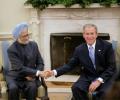
'The nuclear deal required Prime Minister Manmohan Singh to gamble the future of his government on a vision for the future of his nation.'

The top gainers on the Sensex are Gail(India), HDFC, Infosys.

A selection of Indian corporations are cutting costs and contributing to a green economy by embracing clean fuel and India Inc sees a strong business case in adopting renewable energy to power their operations.
A selection of Indian corporations are cutting costs and contributing to a green economy by embracing clean fuel and India Inc sees a strong business case in adopting renewable energy to power their operations.

Like China, India needs to encourage 'hacker clubs' in view of the challenges of virtual terrorism, says Lieutenant General Prakash Katoch (retd)

'India's biggest loss is that we will not have anyone as principled and as courageous as Rajan.'
The wealth of India's richest 1 per cent increased by over Rs 20.9 lakh crore during 2017.

Tech major is in discussion with film-makers, sport administrators to enter the fast-growing sectors.

The S&P BSE Sensex closed at 26,190, up by 43 points and Nifty50 settled above 7,950 to end at 7,963, up by 17 points

Despite inflation easing, experts see RBI maintaining status quo on Dec 2

A large media organisation nominates a batch of senior executives to a customised leadership program designed by a leading business school in India every year.

RBI is expected to slash rates by 150 basis points till end-December 2016.

Mid-caps in cyclical sectors such as cement, financials and capital goods estimated to earn much more

RBI said inflation in the second half of the current fiscal is projected at 2.7-3.2%. It retained its GDP forecast for the current fiscal at 7.4%

In an interaction with Jash Kriplani, A Balasubramanian, managing director and chief executive officer, Aditya Birla Sun Life Asset Management Company, shares his optimism on what makes him believe that these cuts can help in addressing multiple issues plaguing the economy, without letting fiscal deficit pose any major risk.

'Tax cuts will have only marginal effects in the short run and significant positive effects in the medium term,' says Shankar Acharya, former chief economic adviser to the Government of India.

Promoter holding in family-owned firms up 70 bps since 2005, 240 bps since 2010.

From new and competitively-priced iPhones to slashing prices of its older models, it had a multi-pronged strategy.

Global investment is agnostic when it comes to nationalism, says Kanika Datta.

The sale will be quicker if an Indian private bank buys it; it will take longer for regulatory clearances if a foreign bank or an NBFC buys it, points out Tamal Bandyopadhyay.

Recently, Prime Minister Narendra Modi met over 40 CEOs across broad swathes of industry, ranging from makers of mobile devices, auto components, food products to telecom networking equipment and pharmaceuticals. The agenda: To discuss how to make India an integral part of the global supply chain. The focus of the discussion would be the much touted yet not so well understood production-linked incentive scheme (PLI), the centrepiece of the government's drive to massively boost the manufacturing sector. To do so, the government has created a war chest of over Rs 197,000 crore to be paid out as incentives to over 14 industries in five years. There are three objectives to the scheme, two explicitly stated, one implied.
